Initial swelling settles
Temporary post-injection fullness is not the final result.
Collagen biostimulation at Riva
Looking beyond fillers?Rebuild volume gradually.
Sculptra is a collagen-stimulating injectable considered by patients seeking gradual facial volume restoration instead of immediate gel-based dermal filler.
Vascular occlusion is rare but possible with Sculptra and dermal fillers. No facial injectable is risk-free.
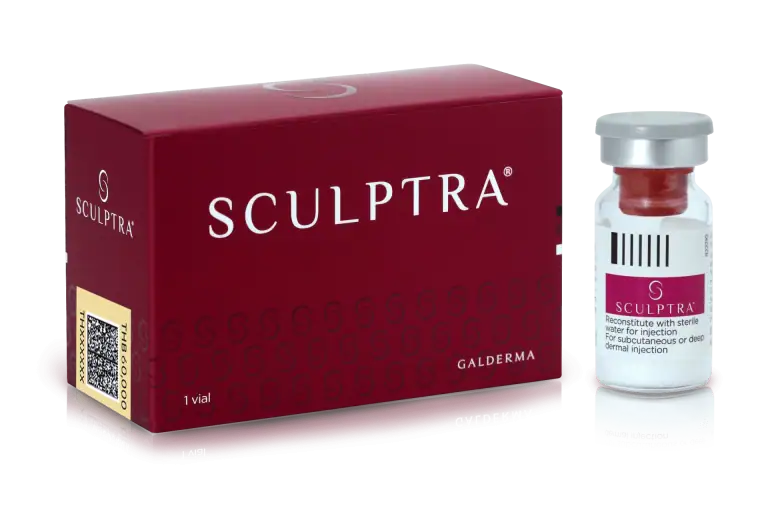
Illustrative mechanism · Individual response varies
The short answer
Sculptra is an injectable poly-L-lactic acid treatment that stimulates collagen production over time. It can provide gradual volume restoration for suitable patients, but it is not an instant or like-for-like replacement for dermal filler.
In the United States, Sculptra is FDA approved for correction of fine lines and wrinkles in the cheek region, shallow-to-deep nasolabial fold contour deficiencies and other facial wrinkles in people with healthy immune systems.
A dermatologist-led assessment determines whether the treatment, anatomical area and expected timeline are appropriate for you.
For patients comparing injectables
It can be an alternative when the goal is progressive facial volume restoration through collagen stimulation rather than immediate volume from a hyaluronic acid gel.
Sculptra and dermal fillers are not interchangeable. Filler may be preferred for precise, immediate contouring; Sculptra may suit broader, gradual structural support. A dermatologist should choose the product, treatment plane and technique only after assessing facial anatomy and the area being treated.
Sculptra is sometimes perceived as safer because it does not behave like an immediate volumising HA gel. However, accidental intravascular injection can still cause vascular occlusion and serious injury. Available evidence does not support a universal “safer than filler” claim.
The treatment path
Each stage prioritises anatomical assessment, conservative planning and measurable follow-up.
A dermatologist reviews facial structure, skin quality, medical history and whether Sculptra fits your goals.
Treatment areas, the number of sessions and product quantity are planned conservatively for progressive correction.
Early swelling settles. Visible improvement develops progressively as the treatment supports new collagen formation.
Progress is assessed between sessions and at follow-up; treatment is adjusted to your individual response.
Results & expectations
Sculptra is selected when the goal is progressive improvement rather than obvious overnight volume. Most clinical-study participants saw results as early as one month.
Clinical studies reported sustained results for up to two years. Individual results may differ.
Temporary post-injection fullness is not the final result.
Improvement may become visible as the collagen response develops.
Your clinician evaluates response before proceeding with the plan.
Treatment comparison
Both are injectable volumising options, but one stimulates gradual collagen formation while the other places immediate gel volume.
| Decision point | Sculptra | HA filler |
|---|---|---|
| Primary role | Collagen biostimulator | Gel-based volume and contour |
| Onset | Progressive, over weeks | Usually visible immediately |
| Treatment style | Series of sessions | Often a single session |
| Longevity | Results may last up to 2 years | Varies by product and treatment area |
| Reversibility | Cannot be dissolved like HA filler | Many HA fillers can be dissolved with hyaluronidase |
| Vascular occlusion | Rare but possible; careful anatomical placement is essential | Rare but possible; HA may be treated with hyaluronidase if recognised promptly |
This is a general comparison, not a treatment recommendation. Product, technique and patient factors materially affect outcomes and risks. The table does not establish that one injectable is universally safer.
Essential safety
Sculptra is a prescription medical device and should be administered only by an appropriately trained healthcare professional.
Content aligned with current US FDA Instructions for Use as of 29 July 2026.
Not for people with severe allergies to product components, or a history of keloid formation or hypertrophic scarring. Active sores, infection or inflammation at the intended site must first be controlled.
Swelling, tenderness, redness, pain, bruising, bleeding, itching and lumps may occur. Delayed nodules or granulomas have been reported.
Unintended injection into a blood vessel can cause vision impairment, blindness, stroke or permanent scarring. Seek urgent medical help for unusual pain, vision changes, whitening of the skin or neurological symptoms after treatment.
Clinical fit
It is “Is this the right treatment for my anatomy, goals and risk profile?”
You prefer progressive, natural-looking change over immediate correction.
Your concern matches an appropriate facial indication and treatment plane.
You understand that a series of appointments may be required.
You can follow aftercare and attend planned clinical reviews.
Frequently asked
These answers are educational and do not replace an individual medical assessment.
Sculptra is an injectable treatment made with poly-L-lactic acid (PLLA-SCA). Rather than acting only as an immediate space-filling gel, it works gradually by stimulating the body’s collagen response in the treated area.
Yes. In the United States, Sculptra is FDA approved for correction of shallow-to-deep nasolabial fold contour deficiencies, other facial wrinkles, and fine lines and wrinkles in the cheek region in immune-competent people. Approval applies to specific indications and trained clinical use; it does not mean every facial or body use is approved.
Hyaluronic acid filler usually gives visible volume or contour immediately. Sculptra produces a more gradual change by supporting new collagen formation. It is not dissolved with hyaluronidase, so careful patient selection, placement and dosing are important.
Sculptra may create gradual facial volume restoration by stimulating collagen, so it can be considered when someone is searching for an alternative to immediate gel-based dermal filler. It is not a like-for-like substitute: Sculptra develops progressively, while hyaluronic acid filler adds visible gel volume immediately. The appropriate option depends on the treatment area, anatomy, timeline and desired degree of contouring.
No injectable treatment should be described as free from vascular-occlusion risk. Sculptra does not create volume in the same way as an immediate hyaluronic acid gel filler, but its FDA Instructions for Use still warn that accidental injection into a blood vessel can cause embolisation, vascular occlusion, ischaemia, infarction, vision loss or stroke. Current evidence does not establish a blanket claim that Sculptra is safer than every dermal filler. Technique, anatomy, treatment plane and clinician training are central to risk reduction.
A typical treatment plan is three sessions spaced at least three to four weeks apart, although the official instructions allow a single regimen of up to four sequential sessions. Your dermatologist may recommend fewer or more within approved guidance based on anatomy and response.
Results are gradual. Most clinical-study participants saw results as early as one month, with sustained improvement reported for up to two years. Timing and longevity vary by patient, treatment plan and biological response.
Many people return to routine activity quickly, but swelling, tenderness, redness, pain, bruising, bleeding, itching or lumps can occur. Your clinician will give individual aftercare instructions and explain which symptoms need urgent review.
US FDA-approved aesthetic indications include fine lines and wrinkles in the cheek region, shallow-to-deep nasolabial fold contour deficiencies and selected other facial wrinkles. Use in the lips, around the eyes or other areas requires specific caution and may be unapproved. Treatment areas should be determined by a trained clinician.
Sculptra is contraindicated for people with severe allergies or hypersensitivity to its components and for those with a history of keloid formation or hypertrophic scarring. Treatment should be postponed when the intended area has an active skin sore, infection or inflammation. A clinician must review pregnancy, breastfeeding, medicines, bleeding risk and medical history.
Common reactions include swelling, tenderness, redness, pain, bruising, bleeding, itching and lumps. Delayed nodules or granulomas can occur. As with other facial injections, unintended injection into a blood vessel can cause rare but serious complications, including vision impairment, blindness, stroke or permanent scarring. Treatment should only be performed by an appropriately trained medical professional.
Cost depends on the number of vials, treatment areas and sessions needed. Riva provides a written treatment and cost plan after clinical assessment, before treatment begins.
Evidence & provenance
Consultation at Riva
Request an assessment to discuss facial anatomy, goals, alternatives, expected sessions, safety and a written cost plan.
+91 72592 18282